

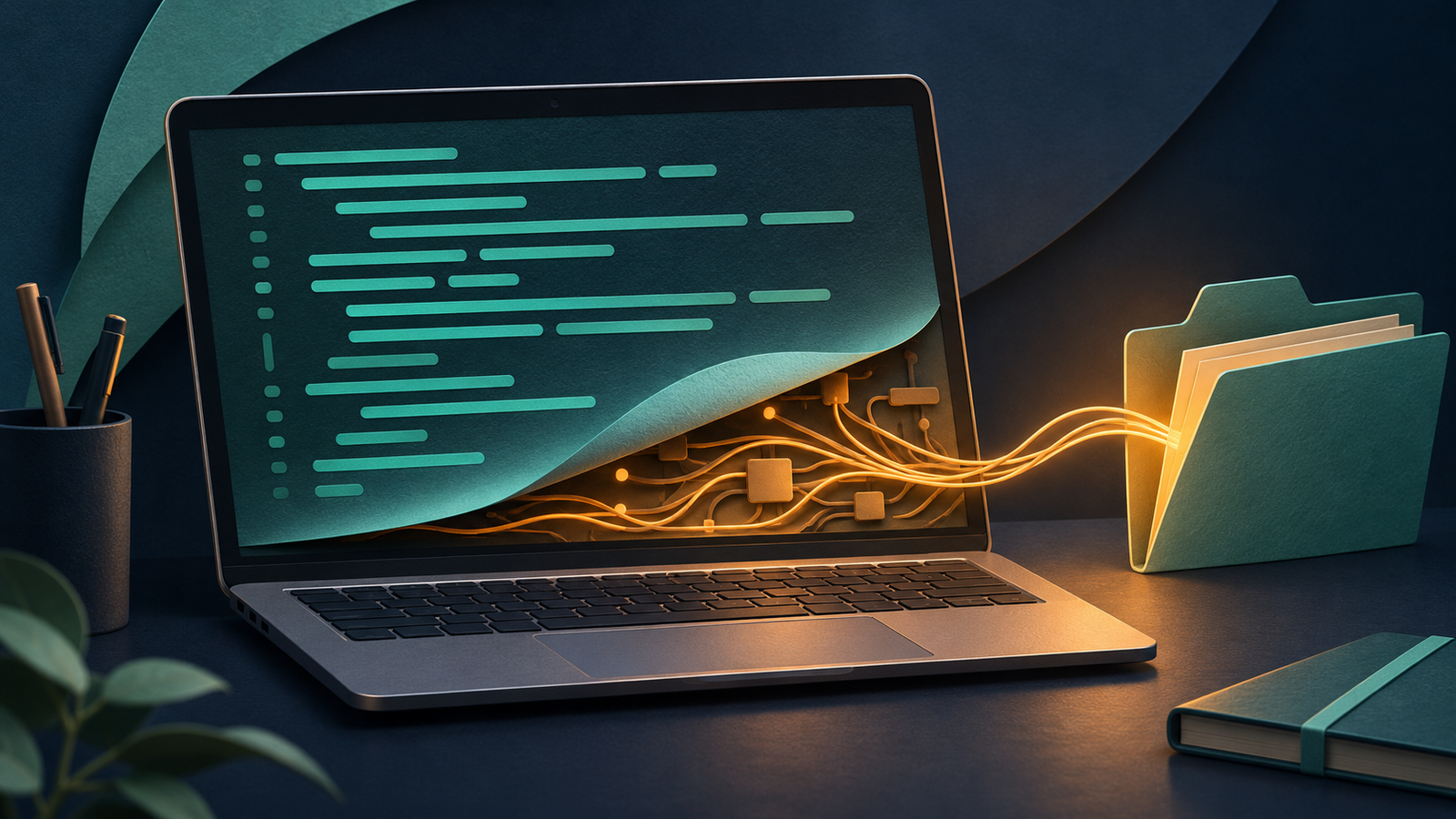
A developer’s account of hidden code, uncertain execution paths, and the work of rebuilding trust after a compromise.
A development command can feel like a reflex. Open the project, install what it needs, start the application. When the dashboard loads and the backend responds, it is tempting to treat that as a sign that everything is working.
Our recent incident forced a different question: what else started when the project started?
During an internal investigation, we found malicious code in our development repositories and evidence that a loader had executed on a Windows development machine. Our incident assessment associated the activity with PolinRider and TasksJacker-style techniques. That assessment is the context for this account, rather than an independently verified attribution of our specific incident.
The file looked finished. It wasn’t.
One detail stayed with me: a file that appeared harmless contained a large obfuscated payload after a long stretch of whitespace. A quick glance could leave the impression that there was nothing more to read.
Other findings were closer to the routines we use every day. A VS Code task was configured to run when a folder opened. Project scripts had been changed to run an additional initialization file before normal startup or build commands. Suspicious code also appeared inside configuration and application files.
These were familiar places with unfamiliar behavior. A task name that sounds like a code-quality check can make an action seem routine. A short addition to a startup script can blend into a command we have run hundreds of times.
The lesson was uncomfortable: the application did not have to stop working for the surrounding workflow to become dangerous.
Where the public research fits
OpenSourceMalware’s PolinRider technical dossier describes malicious JavaScript appended to legitimate project files, including payloads concealed after whitespace. It also documents VS Code task-based execution and malicious code disguised as font assets. Those documented techniques provide context for several patterns in our own findings.
That similarity matters, but it does not answer every question about our machine. Public research explains the broader campaign; local evidence is still needed to establish what happened in a particular environment.
A timeline is evidence, not a complete explanation
Our internal timeline recorded infected project copies being checked out on November 19, 2026. Shortly afterward, an initialization command ran and a directory associated with the loader appeared. Later, investigators found a local staging folder containing collected browser and environment data.
Those observations support a serious conclusion: malicious code executed, and data was collected locally. They do not, by themselves, prove exactly which data reached an external server.
The initial execution path also remains unresolved. A normal project command or an automated development action may have triggered the payload. Events happening close together in time are useful leads, but timing alone does not establish which tool or person launched it.
We applied the same caution to repository history. A name displayed on a suspicious commit is an investigative clue, not enough evidence to accuse that person of making the malicious change.

Stopping the process was only one part of recovery
Initial containment included stopping the loader, isolating affected working copies, and blocking the identified server address. Follow-up scans and checks after a reboot did not show the loader returning at the time of the incident summary.
That was encouraging. It still left questions about the access the malware had while it was running.
A development machine can bring together browser sessions, saved credentials, environment variables, project secrets, and signing material. The impact of a compromise can therefore extend well beyond the repository where it was discovered.
Our summary still listed account security work, credential rotation, checks of other team devices, and repository cleanup as outstanding tasks. A quiet machine after containment is a useful observation. Recovery also requires dealing with what may have been exposed before containment.
What I want to carry into the next project
I want the next code review to pay closer attention to the parts that decide what executes: package scripts, editor tasks, initialization files, and build configuration. Reviewing a feature means understanding the commands around it as well as the feature code itself.
Automation deserves that same attention. An AI coding tool can run a project command, just as a developer can. In our incident, the evidence does not yet establish that an AI agent caused the first execution. The useful question is which execution path was available and what access the environment gave it.
For developers who also work in design, this is another kind of looking beneath the surface. A polished preview tells us how a project presents itself. Understanding its startup behavior tells us more about what we are allowing it to do.
We will keep using open-source projects and development automation. This experience has given me a reason to pause before the next familiar command and ask:
Do I understand everything this project is about to start?
Editorial note: This account is based on an internal incident summary dated November 22, 2026. Internal project names, account details, machine identifiers, and sensitive infrastructure information have been omitted. Some investigation and recovery steps remained open at that point. Technical background is attributed to OpenSourceMalware’s public PolinRider research. The accompanying AI-generated illustrations are conceptual artwork, not screenshots or forensic evidence.