

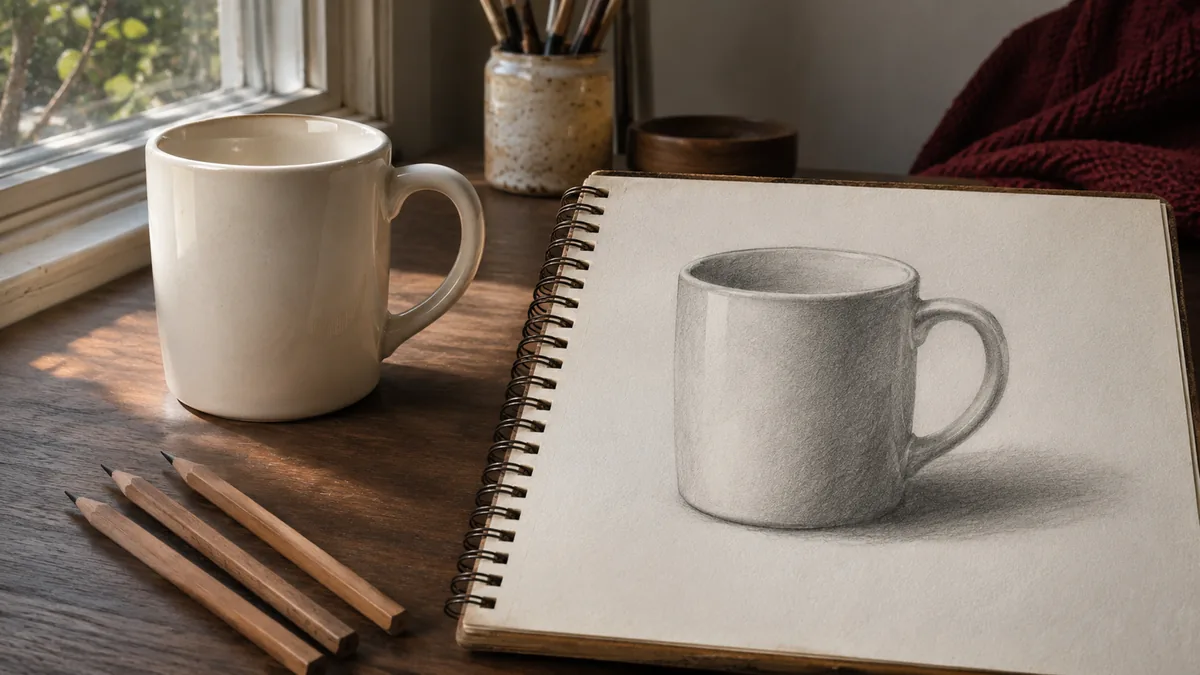
Put a plain mug by a window and turn it until you can see the opening and handle. Before you draw, look for the brightest patch, the darker side facing away from the window, and the shadow the mug casts on the table. Those three shapes will do most of the work.
Set up your three pencils
Open a fresh page in a Kraft Spiral Sketchbook. Pick a hard, middle, and soft pencil from the 12-Piece Graphite Sketching Set. Try 2H, HB, and 4B, or the closest grades you have. On a scrap of paper, make a small swatch with each using the same light pressure. Keep the swatches nearby as a guide.
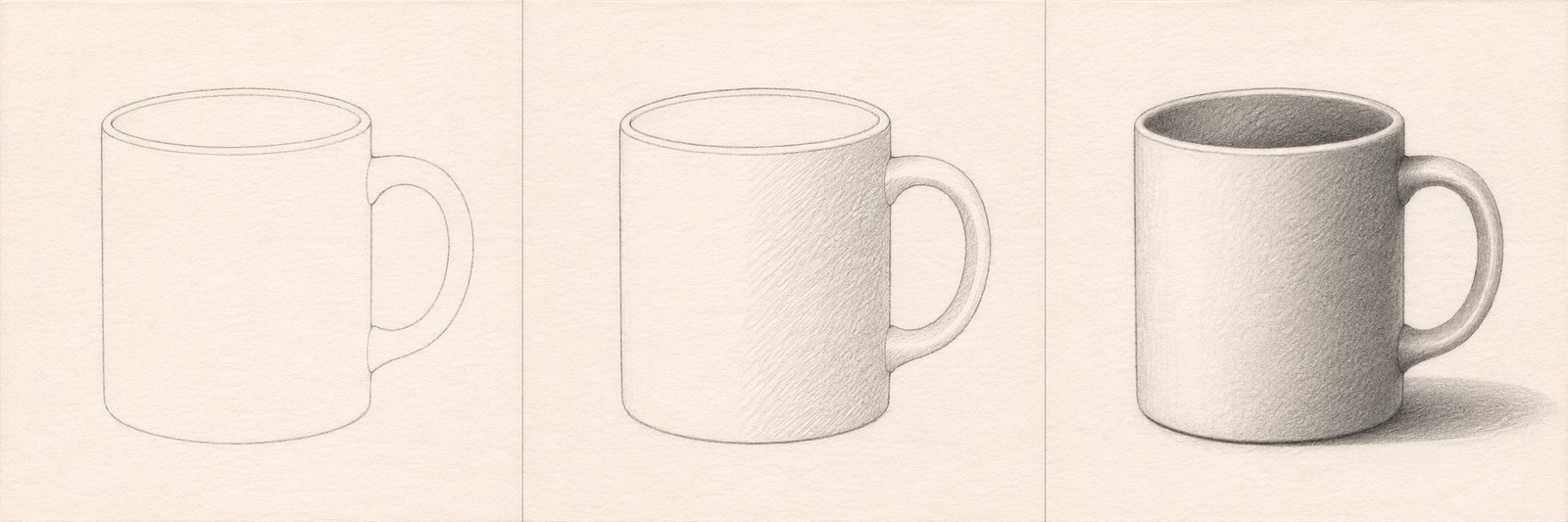
1. Draw a light outline with 2H
Copy the left panel. Draw a wide, shallow oval and repeat it just inside the first to show the thickness of the rim. Drop two short lines from the sides of the oval and join them with a shallow curve for the base. Add a large C shape on the right for the handle, then draw a smaller curve inside it. Keep the inside of the mug and the table blank.
2. Build the middle tones with HB
Follow the middle panel. Tilt the HB pencil and use its side to lay down short, light strokes on the right side of the mug. Start near the handle and ease up as you move toward the center. Shade the inner edge of the handle lightly and leave the left side of the mug as bare paper.
3. Deepen the shadows with 4B
Follow the right panel. With the 4B, add the darkest marks inside the opening, where the handle joins the mug, and along the thin strip right under the base. Leave the thin rim light so it stays visible against the shaded opening. Add a low cast shadow to the right. Keep it darkest next to the mug and lighten your strokes toward the far edge.
Check the sketch from a distance
Set the sketchbook down and squint at the page. Can you still tell the light side from the dark side? Does the base look like it’s resting on the table? If the mug looks flat, adjust the two tones that look most alike before adding more detail.
Try the sketch again with the mug turned the other way. Keep the pencils and light in the same place and watch which shadows move. That small change gives you a second drawing to compare with the first.